
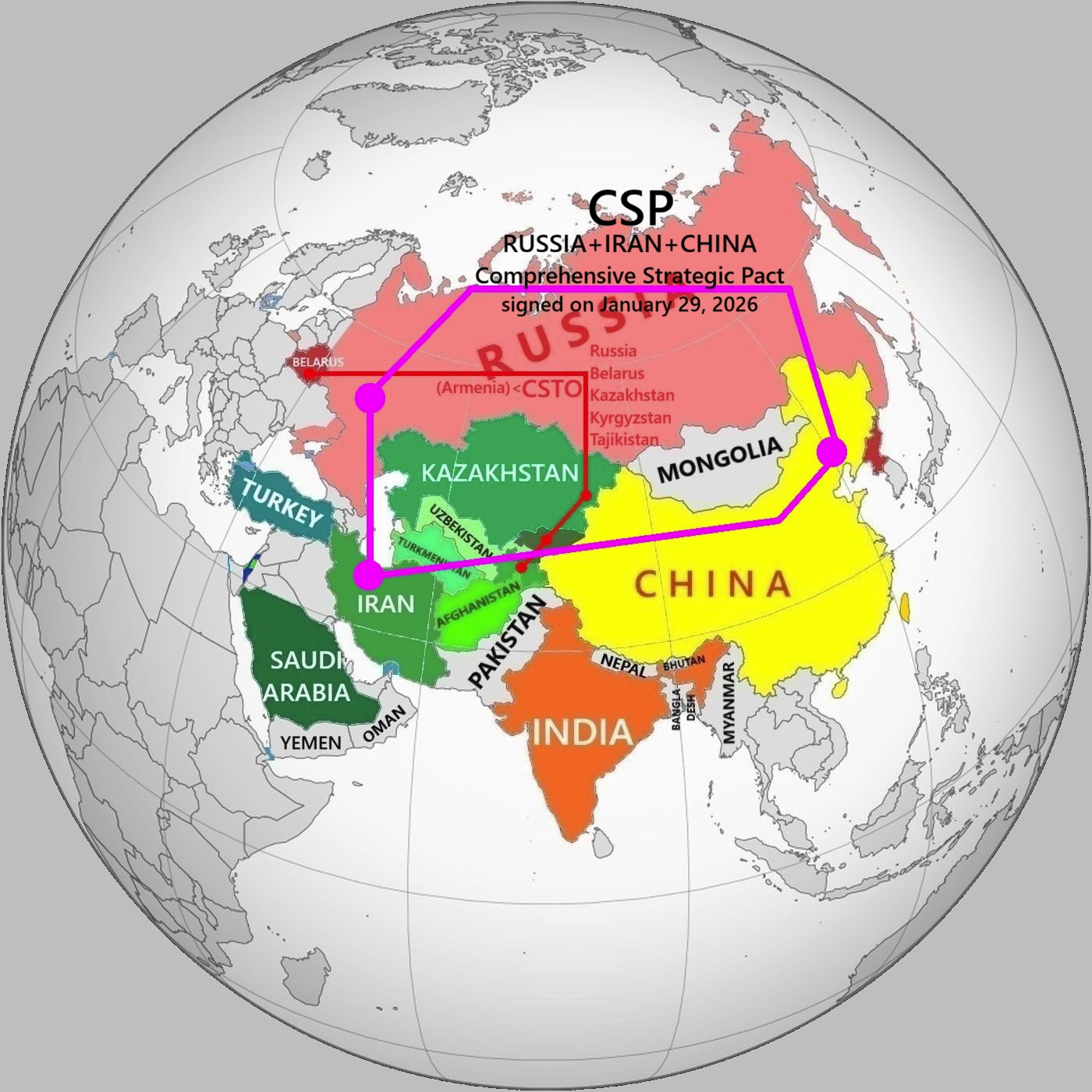
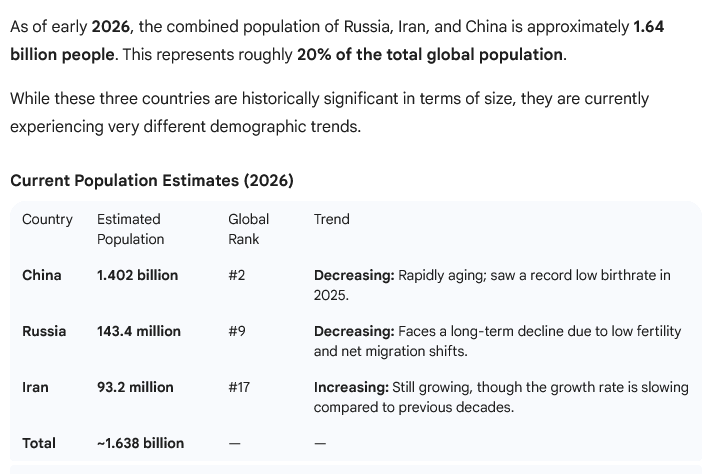
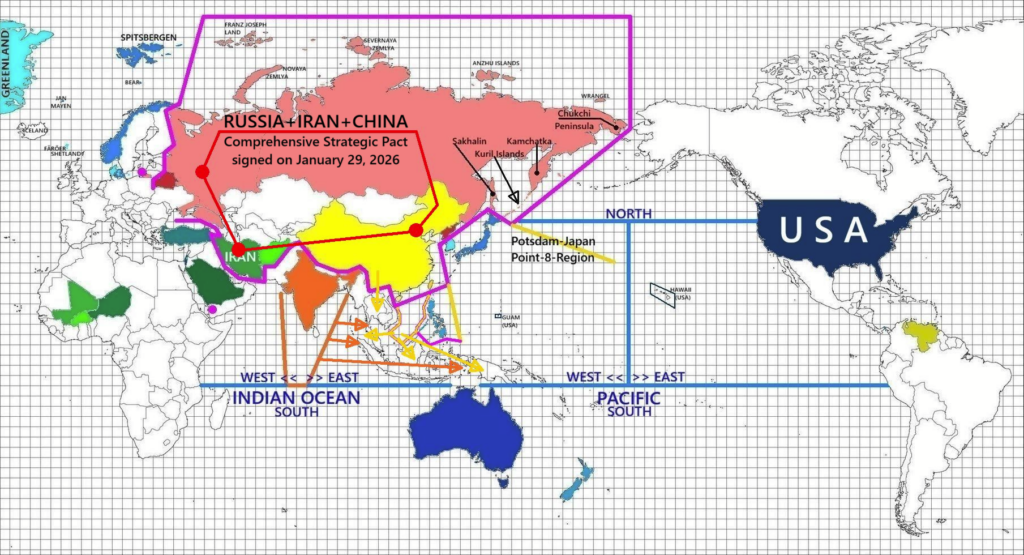
Dass mit dem Comprehensive Strategic Pact der (gemäß Einwohnerzahl) größte Militär-Pakt der Welt geschaffen wurde, sollte allen klar sein.
Man beachte dahingehend die Rimland-Theorie von Spykman:
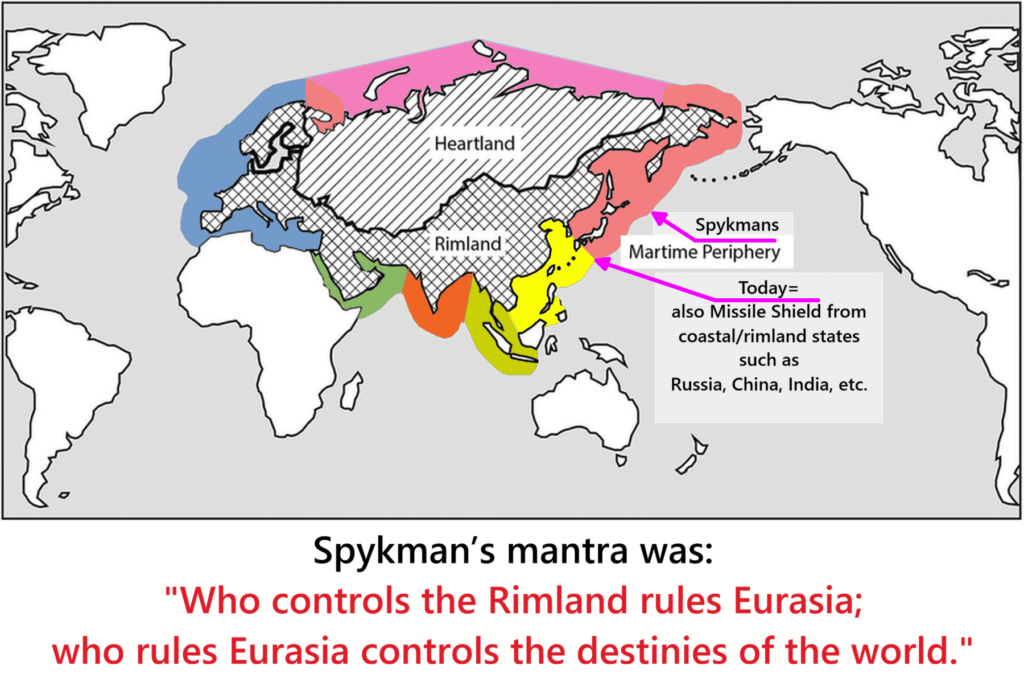
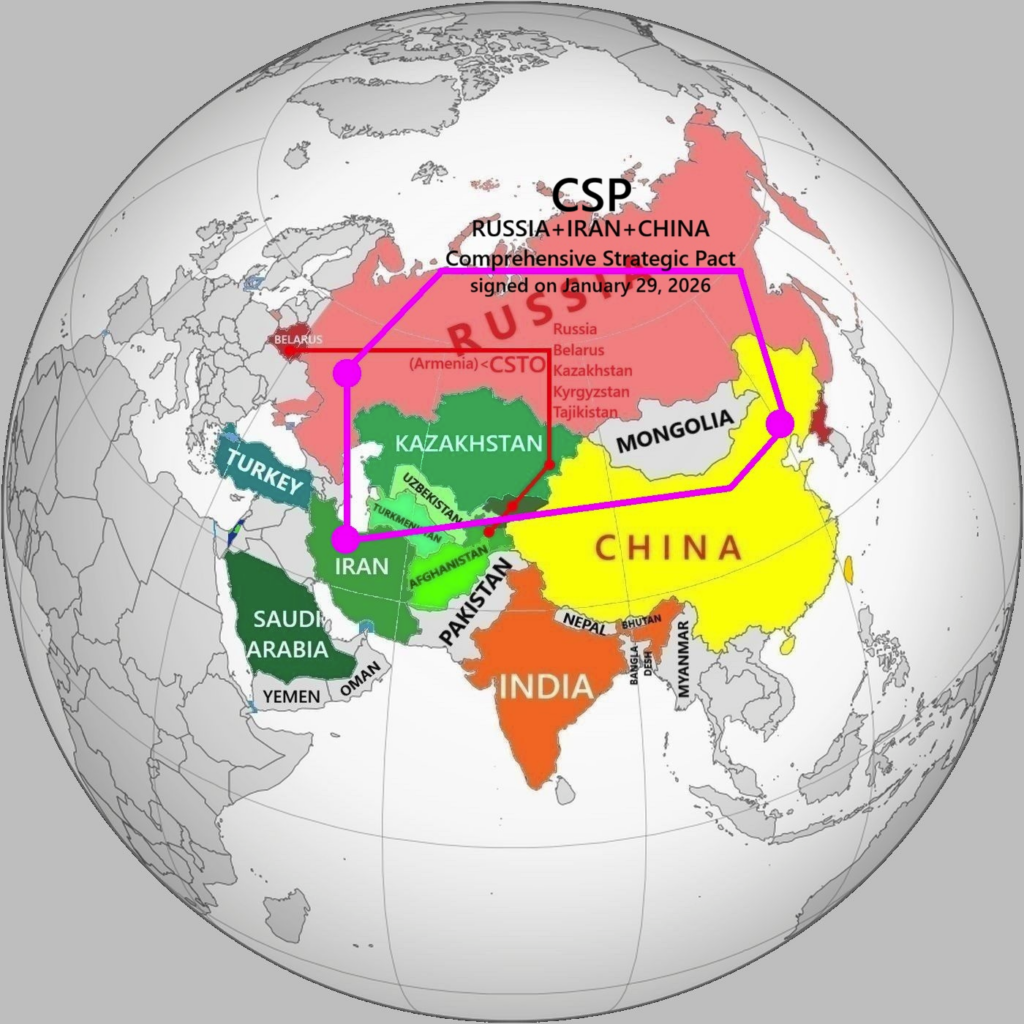
Oben: Das neue arktische Rimland-Küste (siehe pink) ist dazugekommen, seit Spykman damals die geographischen Fixierungen machte. Weitergehend meinte er, die Flotten würden ihre Küsten verteidigen – was stimmt (Martime Periphery), aber heute gibt es auch Raketen, mit denen man die Küsten verteidigen kann (also die Martime Periphery auch als Raketen-Reichweiten-Schirm zur Küsten-Verteidigung).
Unten: Der neue Strategische RIC-Verbund, der (siehe auch Karte oben) große Teile der Rimland-Küsten durch die Raketenschirme dieser RIC-Länder verteidigen kann (siehe Karte unten – auch CSTO dahingehend zu beachten).
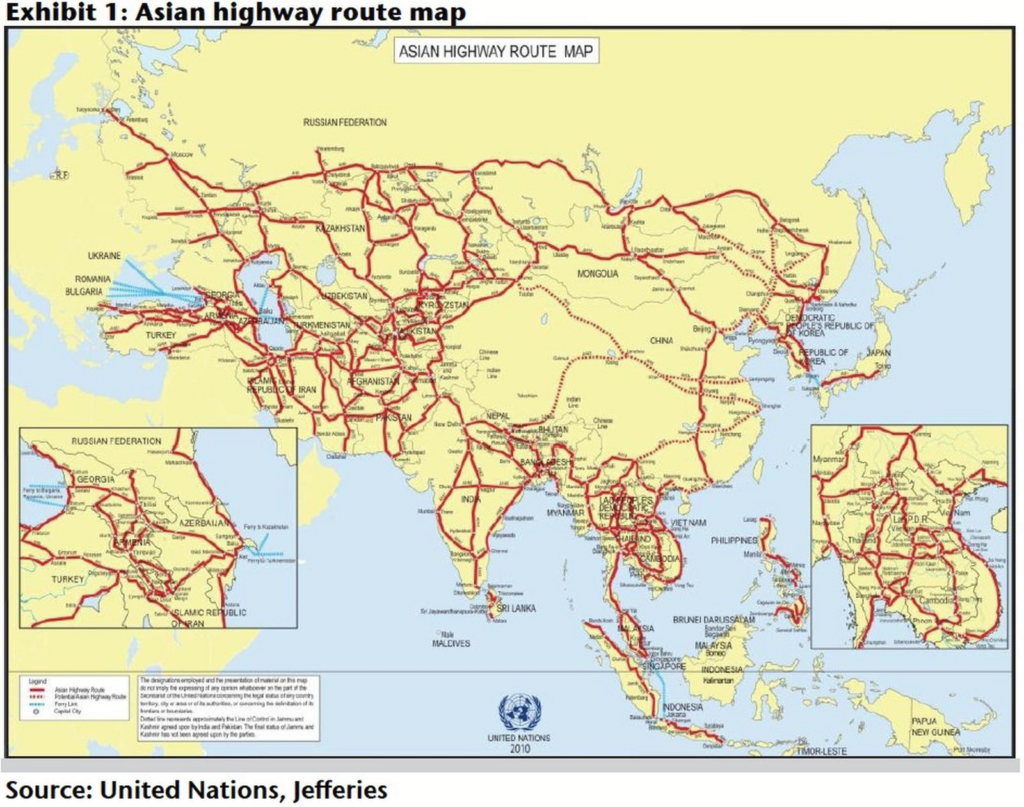
Man beachte dass in Europa ständig mitgeteilt wird, es sei gelungen Russland mehr oder weniger völlig zu isolieren – und die gleichen Experten sagen, so eine Isolierung ist auch mit Iran möglich. >>> Man beachte nachfolgende Eisenbahnkarte von Asien und frage sich – wie soll das gehen – Russland oder Iran zu isolieren?
The Comprehensive Strategic Pact signed on January 29, 2026, specifically addresses sanctions and military cooperation, though it stops just short of being a „mutual defense treaty“ like NATO.
Its primary function is to serve as a geopolitical shield, ensuring that if one member is targeted by the West, the other two provide the logistical and economic „depth“ to keep that member functioning.
1. The „Military Situation“ Clauses
The pact does not contain an „Article 5“ (which would force China or Iran to fight a war on Russia’s behalf). However, it includes several binding military commitments:
- The „No-Help“ Pledge: The members agree not to provide any assistance, logistics, or airspace to any third party (such as the U.S. or NATO) that is engaged in a military conflict with a member nation.
- Operational Interoperability: It formalizes the sharing of satellite data and „intelligence coordination,“ particularly in the Persian Gulf and Central Asia.
- Defense Technology Sharing: It specifically outlines cooperation in „military-technical“ fields, such as drone technology, missile production, and electronic warfare systems.
- Security of Supply: In a military crisis, the members pledge to maintain „uninterrupted supply lines“ for critical goods (like oil or microchips) regardless of external blockades.
2. The „Sanctions“ Defense (Sanction-Busting)
The treaty is essentially a blueprint for a parallel global economy that ignores Western laws. Key content includes:
- Banking Independence: A commitment to fully bypass the SWIFT payment system. The three countries have integrated their national payment systems to allow for „seamless, non-dollar trade“ using the Yuan, Ruble, and Rial.
- Legal Defiance: The pact explicitly states that the signatories do not recognize „unilateral coercion“ (sanctions not approved by the UN Security Council) as legal. They agree to actively help each other bypass these restrictions.
- Unified Trade Corridors: Massive investment into the International North-South Transport Corridor (INSTC). This route allows Russia to ship goods through Iran to Asian markets, bypassing the Suez Canal and other chokepoints where Western navies or customs could seize cargo.
3. Help for Russia specifically
For Russia, this pact is a massive „force multiplier“ against Western pressure:
- Industrial Depth: It grants Russia access to China’s manufacturing base for dual-use technologies that are currently sanctioned.
- Energy Guarantee: It provides Russia with a permanent, diversified market for its energy exports, as Iran and China have committed to long-term infrastructure projects (like new pipelines) that are immune to Western financial seizures.
- Military-Industrial Coordination: The pact legitimizes the „reciprocal flow“ of military aid, such as the exchange of Iranian drone tech for Russian advanced fighter jets and air defense systems.
Summary Table: 2026 Pact vs. NATO
| Feature | Comprehensive Strategic Pact (2026) | NATO (Article 5) |
| Commitment | Strategic & Logistical Assistance | Direct Military Intervention |
| Sanctions | Explicitly Vows to Bypass/Ignore | Not a Primary Focus |
| Economic | Unified Parallel Banking & Energy | Trade is Handled by EU/Bilateral |
| Military | Joint Drills & Tech Sharing | Integrated Command Structure |
In Google Sheets exportieren
Would you like me to look into the specific naval exercises scheduled for February 2026 that were announced as part of this pact?
+++***+++
As part of the Comprehensive Strategic Pact signed on January 29, 2026, the three nations have immediately moved into a phase of „operational alignment.“ The most significant military demonstration of this pact is the „Maritime Security Belt 2026“ naval exercise, scheduled for mid-to-late February 2026.
This isn’t just a routine drill; it is designed to signal the practical reality of the new treaty to the West.
1. „Maritime Security Belt 2026“ (Late February)
The eighth edition of this exercise is taking place in the Northern Indian Ocean and the Gulf of Oman. Unlike previous years, this version is explicitly linked to the new trilateral pact’s goals of „maritime sovereignty.“
- Participants:
- Iran: Units from both the regular Navy (Artesh) and the IRGC Navy.
- China: Expected vessels from the 48th Flotilla (including guided-missile destroyers like the Tangshan and frigates like the Daqing).
- Russia: Likely led by the Udaloy-class frigate Marshal Shaposhnikov, supported by logistics vessels already stationed in the region.
- Key Operations:
- Sanction Protection: Drills focused on „safeguarding maritime economic activities,“ which is code for protecting oil tankers from seizure or interference.
- Rescue & Recovery: Scenarios involving the liberation of „hijacked“ vessels (a direct response to recent maritime tensions in the region).
- Tactical Interoperability: Testing unified communications systems to allow Russian, Chinese, and Iranian ships to act as a single fleet.
2. Help for Russia (The „Anti-Sanction“ Pillar)
You asked specifically about helping Russia against Western sanctions or in a military situation. The February 2026 developments clarify how this works:
- The „No-Help“ Clause: One of the most critical parts of the 2026 Pact is a binding agreement that none of the three members will provide logistical support, airspace, or territory to any „third party“ (like the U.S. or NATO) that is in a conflict with a member. This effectively blocks the West from using certain regional corridors to pressure Russia or Iran.
- Airlift Support: In late January 2026, coinciding with the pact’s signing, China reportedly initiated a „rapid airlift“ of 16 cargo planes to Iran. This is viewed by analysts as a logistical „stress test“ to show they can move military-technical aid between the three countries despite Western blockades.
- Digital Sovereignty: China has begun implementing a strategy to replace Western software and hardware in Iranian (and Russian-integrated) systems with „closed Chinese systems.“ This is designed to shield Russia’s and Iran’s critical infrastructure from Western cyberattacks during a „military situation.“
3. Diplomatic and Economic „Depth“
The treaty ensures that if Russia faces a „military situation“ in the West:
- Iran and China act as the „Rear Guard“: They provide the industrial and energy depth to keep Russia’s economy from collapsing under „Total Sanctions.“
- Alternative Banking: The 2026 Pact formalized a unified national payment system that bypasses SWIFT entirely, allowing Russia to continue selling energy and buying technology in Yuan or Rials, effectively making Western financial „death penalties“ obsolete.
+++***+++***+++
The trilateral Comprehensive Strategic Pact signed on January 29, 2026, represents the first time Iran, China, and Russia have merged their separate bilateral deals into a single, unified „coordinated framework.“
While the full text is released in stages, official summaries from Tehran, Beijing, and Moscow outline the following core content:
1. Security and „Mutual Deterrence“
Unlike NATO, this is not a mutual defense treaty (there is no „Article 5“ requirement to go to war for one another). Instead, it focuses on:
- Intelligence Sharing: Formalizing the exchange of tactical and strategic data between the three nations‘ security agencies.
- Interoperability: Committing to regular trilateral military drills (building on the „Sea Security Belt“ exercises) to project force in the Persian Gulf and Indian Ocean.
- The „No-Help“ Clause: A binding agreement that no member will allow their territory to be used for military action against another, nor will they provide any aid (logistical or military) to a third party (e.g., the U.S. or Israel) attacking a member.
2. Sanction-Busting (Economic Resilience)
A major portion of the pact is dedicated to rendering Western sanctions ineffective:
- Alternative Financial Systems: Accelerating the move away from the SWIFT payment system and the U.S. dollar, utilizing national currencies (Yuan, Ruble, Rial) for all major trades.
- Energy Lifelines: Russia and China provide technical infrastructure to Iran’s energy sector in exchange for guaranteed, long-term oil and gas supplies at set rates.
- The North-South Corridor: Joint investment in the International North-South Transport Corridor (INSTC) to create a supply chain from Russia through Iran to the Indian Ocean that completely bypasses Western-controlled maritime routes.
3. Diplomatic and Nuclear Sovereignty
The pact creates a „unified diplomatic front“ on the global stage:
- Nuclear Shield: Russia and China have formally aligned with Iran’s position against the „snapback“ of UN sanctions related to its nuclear program, effectively declaring those sanctions terminated in their eyes.
- Sovereign Internet: Cooperation on developing a „National Information Network“ to ensure cyberspace stability and prevent Western digital interference.
Comparison of the Frameworks
The 2026 Pact is the „umbrella“ that sits on top of these pre-existing foundational treaties:
| Agreement | Signed | Focus |
| Iran-China Deal | March 2021 | 25-year, $400B economic and infrastructure plan. |
| Iran-Russia Treaty | Jan 17, 2025 | 20-year security and military-technical partnership. |
| Trilateral Pact | Jan 29, 2026 | Unifies the three powers into a single geopolitical axis. |
In Google Sheets exportieren
Significance: Critics in the West have labeled this the „Axis of Evasion,“ while the signatories call it a „cornerstone for a new multipolar order.“